Sunday, March 13, 2011

We Would Have Been Safe


I grabbed the flashlight from my backpack and aimed it at the book. I saw maps and drawings, pictures from magazines and newspapers and the Internet, pictures I'd taken with Grandpa's camera. The whole world was in there. Finally, I found the pictures of the falling body.

Was it Dad?

Maybe.

Whoever it was, it was somebody.

I ripped the pages out of the book.

I reversed the order so the last one was first, and the first was last.

When I flipped through them, it looked like the man was floating up through the sky.

And if I'd had more pictures, he would've flown through a window, back into the building, and the smoke would've poured into the hole that the plane was about to come out of.

Dad would've left his messages backward, until the machine was empty, and the plane would've flown backward away from him, all the way to Boston.

He would've taken the elevator to the street and pressed the button for the top floor.

He would've walked backward to the subway, and the subway would've gone backward through the tunnel, back to our stop. Dad would've gone backward through the turnstile, then swiped his Metrocard backward, then walked home backward as he read the New York Times from right to left.

He would've spit coffee into his mug, unbrushed his teeth, and put hair on his face with a razor.

He would've gotten back into bed, the alarm would've run backward, he would've dreamt backward.

Then he would've gotten up again at the end of the night before the worst day.

He would've walked backward to my room, whistling “I am the Walrus” backward.

He would've gotten into bed with me.

We would've looked at the stars on my ceiling, which would've pulled back their light from our eyes.

I'd have said “Nothing” backward.

He'd have said “Yeah, buddy?” backward.

I'd have said “Dad?” backward, which would have sounded the same as “Dad” forward.

He would have told me the story of the Sixth Borough, from the voice in the can at the end to the beginning, from “I love you” to “Once upon a time. . .”

We would have been safe.


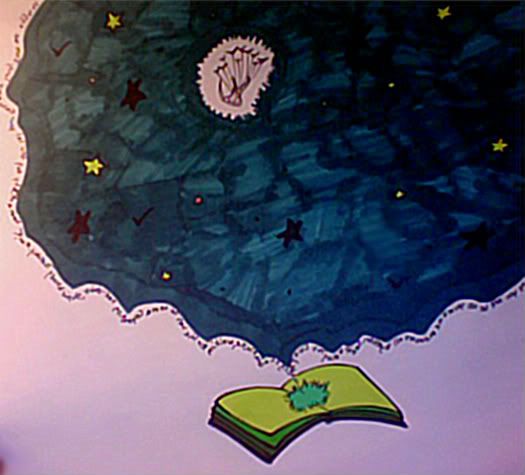
(note: my scanner wasn't working properly and so the picture of my drawing makes it look much worse than it actually is)

My illustration shows Oskar's book, exploding out a dream of the falling man being lifted by a flock of birds (even without a birdseed shirt) back up into the air, back into the tower, like he wished his father could have done. The outline of the dream is the lyrics to the song "I am the Walrus" backward.

I chose this passage because it is the final message of the novel and the reader gets to see Oskar's innermost feelings. It's one of the passages that stuck with me after I put the book down.

There are many times in which a similar scenario plays in my head. I lost my father, like Oskar (although not nearly in the same way) and I often think about how I could just go back in time, reverse everything, and try to make it work again. Unlike Oskar, I don't remember my worst day at all. I never knew what it was like before he passed away, but I just knew that something went wrong in order for this disaster to happen. I often imagine different scenarios about what could have happened and how my life could be different, but the past doesn't change, and we have to eventually move on.


BLOG 5

Branden Stevens
3/13/11

Dad constantly used to tell me I was too smart for retail. I told him that. "First of all," he told me, “I’m not smarter than you, I'm more knowledgeable than you, and that's only because I'm older than you.” “Parents are always more knowledgeable than their children, and children are always smarter than their parents." (Pg.7)

I found this quote to be important because it’s a direct reflection of the relationship of the main character and their father. In a way it also reveals the simplest of truths, my parents always tell me that I’m smarter than them and they look forward to seeing me do great things. Every parent wants the opportunity to see their children better off than they are. To be this quote from the book stood out the most interesting of all considering my father has always told me he never wanted me to fallow in his footsteps and has always encouraged me to go into a different direction with my career, not because he felt I was incapable but simply because he wanted me to find and chase my own dreams. So for me this made my connection with Oskar on a stronger level, I began to look at the story with more of an empathetic side so when Oskar’ father died, the emotions displayed in the book were easily imaginable.

The picture I chose also connects my emotions with that of the main character. I feel like there are certain bonds a father and son share that are almost unexplainable it’s a special feeling when your father puts you on his shoulders and he becomes someone you admire and dream of fallowing in their footsteps, a lot like Oskar and his father I too at one point wanted to fallow in my dad’s footsteps and my dad was in an extremely similar situation as Oskar considering his father passed away when he was 14. The whole idea of losing your greatest role model is really evident and I think the author does a great job of stressing the father son relationship in the novel.

Cat and a Key


Casey, Psycho, My Secret Box Key, and Simba.


“As he walked out of the room, Jimmy said, “Hey, Oskar, who’s Buckminster?”. I said, “Buckminster is my pussy” (Foer 190).

“Even though I knew that there were 161,999,999 locks in New York that it didn’t open, I still felt like it opened everything. Sometimes I like to touch it just to know that it was there, like the pepper spray I kept in my pocket. Or the opposite of that. I adjusted the string so the keys – one to the apartment, one to I-didn’t-know-what- rested against my heart, which was nice, except the only thing was that it felt too cold sometimes, so I put a Band-Aid on that part of my chest, and the keys rested on that. (Foer 200).

I chose this passage because it was an odd passage in the book that I could relate to. I used to get picked on quite often when I was about Oskar’s age. I enjoyed reading and playing with paints, but the one thing that seemed to give me the most joy were my cats and the key I wore on a bracelet I made that opened my Secret Box. I had all the most valuable items that my Grandfather had given me into that box and I clung and fumbled with the key every day, especially after he was gone. I clung to them for companionship when I felt no one else in the world understood how difficult life could sometimes be. I feel that Oskar has a similar situation with his cat, Buckminster, and the key he wears around his neck from his father. But, why do we tend to cling to creatures or objects when everything seems to be going down the drain?

Maybe we cling to our animals and pretend that they understand what we are saying to help dull the pain. My pain was because I was being bullied by other kids at school and had to help my grandmother every afternoon after school. I would have to help take care of my dying grandfather who had already had the lower part of his left leg amputated due to horrible circulation. I was terrified to look at him because he looked as if his skin was hanging from his bones and he always had a face full of anguish and pain. When I went home after mom had picked me up I ran to my room and grabbed my kitty, Psycho, off the bed and just held her close. I felt that if I could be proud of anything at the time, it was her. She seemed to be the only living creature that I could count on to listen to me. When I read this passage it reminded me of this time even though I was ten years old instead of nine. I think that Oskar clings to his cat and the key that he found so that he can still believe that even though his father is gone from him, that he still carries him on his heart every day. In this way his father will always be with him. He clings to his cat because he is someone that will understand and not be judgmental or argue with you about what you think or believe. They just listen and love you without really ever understanding even though it seems like they do.

Blog 5: Backwards

"I'd have said "Dad?" backward, which would have sounded the same as "Dad" forward. He would have told me the story of the Sixth Borough, from the voice in a can at the end to the beginning, from "I love you" to "Once upon a time..." We would have been safe" (326).


This is how the entire novel ends: with Oskar wishing for everything to simply go backwards, for everyone's lives to speed through on rewind so that everything that happened to his father on the day of September 11, 2001, can be taken back.

I chose this particular picture because, even though it's just a toddler in the picture, it still conveys the same emotions that I felt when reading that particular passage of the novel. It seems desperate. Oskar is mature in many ways, but at the same time he's still just this little boy, feeling like the whole world is rushing around him in a blur while all he really wants right now is to have his father back.

I've never lost anyone quite that close to me, so I can't honestly say that I understand what Oskar was going through. I've felt that emotional pain before, though, and to be truthful, I'm impressed by how Oskar continues to push forward despite this huge tragedy in his life. I admire him for that. If I was in his situation, I really doubt that I could keep going on the way he does.

I'm not just saying that I like the last part of the book simply because it was the end; I actually really liked the backwards concept. Very few people will ever go through their entire life without thinking, "I wish I could do this over again." Oskar is very relatable in this way because that's what so many people in life wish for. Everyone just wants a do-over, a second chance.

Morgan Bernstein

Blog 5 GDP


“In the back seat, Mom was holding something in her purse. I could tell that she was squeezing it, because I could see her arm muscles. Grandma was knitting white mittens, so I knew they were for me, even though it wasn’t cold out. I wanted to ask Mom what she was squeezing and why she had to keep it hidden. I remember thinking that even if I were suffering hypothermia, I would never, ever put on those mittens.” Page 5.

I choose this passage of this section because it reminds me a lot of me. Back in 2001 my great grandmother died. I was eleven. I never got to really know my grandmother that well. My great aunt used to come down from Holland and visit and take care of her; if I was good on the weekends I could go to the retirement home with my great aunt. When my great grandmother died all I remember thinking was great now auntie will never come back, there is no reason for her to visit now. I was crying for the wrong reason. The funeral was held in New Jersey. I got to visit all the places my family would talk about in the “old days.” I was mainly excited to be missing school. The whole trip I didn’t think once of how sad it would be to not have my great grandmother at Christmas anymore. At the funeral I didn’t cry. I kept thinking when is this going to be over. I saw my grandmother and great aunt crying for the first time. They seemed even more upset when they looked at me. At that point I tried to make myself cry, I felt like such a bad family member for not being able to cry. I’ve had three other family members die since then. And every time I’ve never been able to cry. I always felt like it was coming eventually.

But anyway, I really liked this passage because I reminded of the funeral I went too. How my mind was everywhere but where it should have been like all my feelings were wrong. Everyone was really clingy and apologetic. My grandmother kept feeling sorry for that I never got to know my great grandmother. But she was 100 and I still feel like the tears are better put elsewhere. I spent eleven years getting to know my great grandmother and she still liked me seen but not heard. That sentiment makes it hard to get to know someone. Oskar was an atheist when his father died. But really I think we were just both really practical for our ages and just enjoyed what the moment brought us. Him a limousine and I a break from school.

Oskar


This is a picture that I drew of Oskar.

I'm Blue

“No matter how much I feel, I’m not going to let it out. If I have to cry, I’m gonna cry on the inside. If I have to bleed, I’ll bruise. If my heart starts going crazy, I’m not gonna tell everyone in the world about it. It doesn’t help anything. It just makes everyone’s life worse….” “But if you’re burying your feelings deep inside you, you won’t really be you, will you?” [203]

I chose this painting to illustrate the passage. It’s one of my paintings entitled I’m Blue. I felt that this painting would best express what the quotation is saying. I used this painting the same way that Oskar used the things in his scrapbook to express his feelings. I could really relate to the quotation above from the book as soon as I read it. It stuck in my mind. When I read it I thought about the painting and how I felt at the time that I was painting it. The quotation is a perfect expression of my experience. Oskar was hurting the same way I was. There have been many times in my life that I have kept my feelings hidden deep inside of me. I just couldn’t seem to let them out. I didn’t want to share them to anyone. Just like in the quotation my heart was going crazy. It was out of control. I felt as though I couldn’t calm or console my heart no matter how hard I tried at the time. There have been times that I felt as though I were crying on the inside but I wanted to do my best to hide it from the rest of the world. It just didn’t seem fair to rain on someone else’s parade. When I was hurting, I didn’t want others to hurt so I kept my feelings hidden sometimes from those I loved. As I grew older I realized that it was not good to keep things hidden deep inside of you. I have come to realize that my feelings helped mold me into the person that I am. We all will have times like these in our lives. They will not last forever. They make us stronger and help us to grow. These are experiences in our lives that we can look back on and know that we are better because we made it through them. Sometimes it’s hard to think of the sunshine when rain is falling into your life, but we all know that it not only takes sunshine but also rain to make things grow.

She asked, “Aren’t my life and my feelings the same thing?” (page 130)

I picked this picture because it reminded me of Oskar’s scrapbook called “Things That Have Happened to Me.” In my own way, it tells my experiences, my feelings, and my life. This is a truly powerful quote. It is true. Feelings bring meaning to a person’s life. Without having feelings, there would be no reason to live. There would be no love, no fear, no sadness, and no happiness. Feelings have a weird way of ruling your life. They impact your life greatly. Although sometime your feelings can be painful, like that of Oskar’s, it can cause you to grow, and in way understand someone else’s pain.

In Oskar’s scrapbook he placed his feelings on paper visually. I think Oskar’s scrapbook is a big part of the novel. His feelings are expressed through pictures he takes with his grandfather’s camera, clips from the magazines, prints off the internet and the scratch pad at the art supply store. They all deepen the experience of seeing the world through Oskar’s eyes. Oskar’s pictures give the meaning of the story. Oskar’s perspective is limited because he is a kid. His grief and fear are shown through these pictures. They are dark and have an eerie feel to them. His facts and statistics that he rambled on about, were just a way to put distance between the feelings. The 9/11 experience he encountered gave him a horrible feeling; however his pictures can’t hide his feelings like his words can.

Blog 5


"I don't recognize the world anymore." (pg. 127)

In this part of the story, Oskar and Anna are alone behind a wall of books. Oskar overhears Anna's father say, "I don't recognize the world anymore." Then a bit later, Mr. Goldberg says, "I've never recognized it more." After a while, they start talking about war, and how people are killing for no purpose. Mr. Goldberg says, "... It is war waged by humanity against humanity, and it will only end when there's no one left to fight."

When I read this part in the book, I could really connect. I think anyone can really. We say that we don't recognize this world because of all the change that is happening, along with the disasters and tragedies we suffer through. We say this because the world isn't quite the same as it used to be. It becomes something more and more as years go by. At the same time, like Mr. Goldberg says, we do actually recognize it. We know exactly what is going on and why. Like war for instance, the example they use in the book, it is ongoing and will not stop. We don't want to believe that, and we see, it is getting worse. It is progressing, changing. But at the same time, we do recognize what is going on, and why. People are fighting until death, until they have completely wiped the other side out, but in the process they are being defeated as well.

When I read that line, I honestly do not know why, but it reminded me of Alice In Wonderland. That's why I used this picture. Alice accidentally stumbles into a new and unfamiliar world where anything that happens is dream like, impossible. When I think of the war that is going on now, I think of it as a dream. I know that sounds silly, but I think of it as a dream because I am in denial of what the world is coming to. When I was a kid, honestly, I did not watch the news so I thought that war was only in movies. Now, when Alice travels through this dream world, a lot of the characters have some sort of resemblance to the people in her life. This is what she recognizes. With the war that is going on now, I recognize that it is petty, and we are fighting it because we can. The true reason behind it is stupid, and not worth the fight.

When Alice wakes up from her dream, she uses it to make the decisions she wants to. When I look away from this war to my life, I use it to keep myself safe from the world, and the people in it.